Canadian men’s team writing its own myths at World Cup

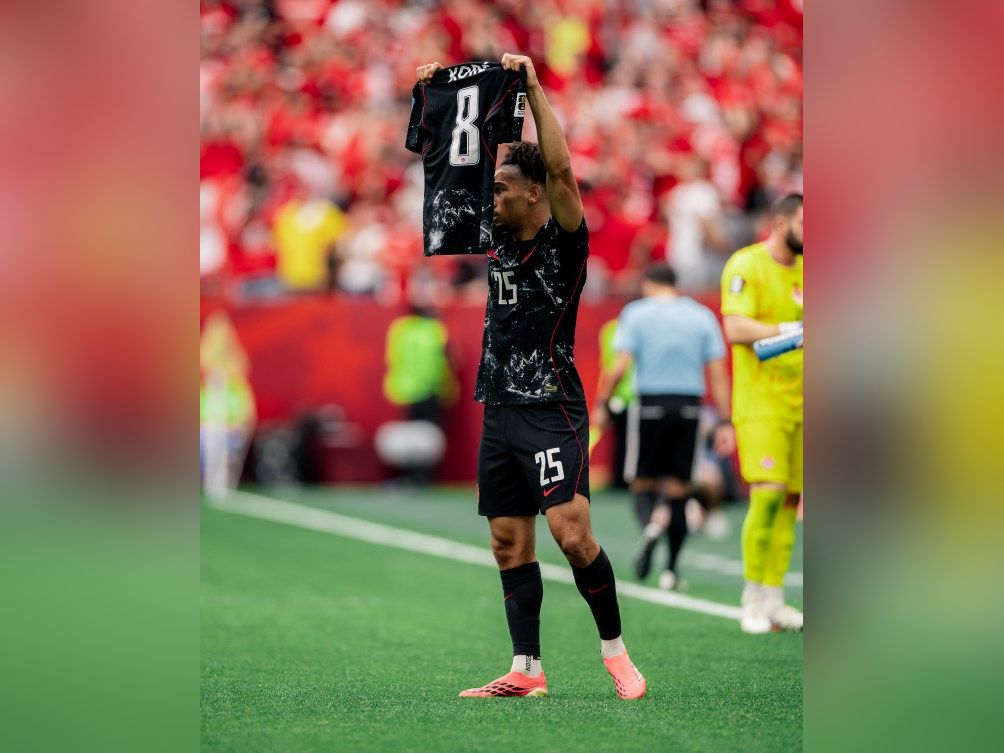
Nathan Saliba holds up Ismaël Koné’s jersey after scoring in Canada’s group stage game against Qatar in the 2026 men’s World Cup. PHOTO AUDREY MAGNY/COURTESY OF CANADA SOCCER

After Canada’s 1-0 men’s World Cup knockout win over South Africa, Jesse Marsch pulled his players together and told them, “you are Canadian heroes.”

“Canadian heroes for the future children of this country who play this sport,” he told the huddle, with a camera and a mic at full attention. “This sport has a big future because of you guys. You should be so proud of who you are.”

This moment has already ricocheted around headlines and promo packages alike, and whether it was spontaneous or performative has also been debated, including by Marsch himself, immediately after the press conference, who said “frankly, I don’t give a shit,” before the ink had already dried on the moment itself. 

When I first heard it, filled with elation after the win as people cleared out of a watch party on Saint John’s waterfront, I thought, “wow, Jesse is cutting a promo,” in a wrestling sense: talking people into the building, creating a moment designed to further pull casual Canadian sports fans into the team’s orbit.

This conscious sense of mythmaking has been an undercurrent of a World Cup campaign for Canada’s men’s national team that already felt dreamlike from the moment that a ball was kicked in “Toronto Stadium” and descended into delirium when a team which had never recorded a win in the tournament ran up the biggest margin of victory ever recorded by a non-European or South-American team. 

It has been a surreal experience, after years following the ins and outs of North American soccer, to see something as arcane, and, honestly, as nerdy as CONCACAF blown up on the international stage. You can get chips at the grocery store with Richie Laryea and Nathan Saliba’s face on it. That’s worlds away from when I first started watching in the late 2000s, when you had away matches that didn’t get a Canadian broadcast and had people listening to St. Vincent radio, hearing ads for “Philip’s Bakery” and goofing about them online.

In those years, the feeling as fans was that we were almost there, but the moment where we arrived never came. Despite strong showings in Gold Cups (Atiba was onside, by the way), the very talented men’s teams of the 2000s and 2010s somehow saw the wheels fall off when it came to World Cup qualifying time. 

The Canadian women’s team saw those barriers bend and break when it came to the Olympics, defeating top-ten teams en route to bronze in 2012 and 2016 as well as gold in 2021, bringing joy to supporters and drawing in a new generation of fans. But the men’s team was still shut out of the World Cup, weighed down by nightmares like the 8-1 loss to Honduras which ended their 2014 qualifying campaign.

The glee of qualifying for the 2022 men’s World Cup was a new frontier, with a sense of banishing those bad memories and proving that with players like Alphonso Davies and Jonathan David, we had established ourselves on the same level as Mexico and the U.S., who had themselves been established as a regular part of the international firmament. 

But just like in 1986, the national team went in and out of the World Cup without a win or a draw, with Davies scoring Canada’s first-ever goal as the only milestone to move, even as Croatia demolished them 4-1 and barred the path to the knockout rounds. Even then, that tournament felt like a dress rehearsal for this one. An endless series of tuneups and trials that included semifinal runs in the 2024 Copa America and 2025 CONCACAF Nations League, but saw Canada’s best racing to fitness as the opening day approached.

Now, Canada is on the biggest stage there is, and so many of those invisible barriers have fallen. Cyle Larin scored Canada’s second-ever goal at the tournament (not counting own goals) as Canada eked out a draw against Bosnia and Herzegovina, who themselves had knocked out Italy in qualifying. 

Then, the power and violence of Canada’s 6-0 shellacking of Qatar in Vancouver, which had a sense of joyful disbelief up until the moment you could hear Ismaël Koné’s leg break. It was heartbreaking, and it was personal, and when Koné’s replacement, Saliba, scored Canada’s fourth moments later and held up his No. 8 jersey, something shifted. 

Canada had an edge now, and something to fight for. The Reds never let up on Qatar, and ended up with the kind of scoreline reserved for Germany at World Cups. This was no longer a question of whether Canada could prove themselves at the men’s World Cup, but an invitation for fans to think, how far can we go?

The mythmaking of the moment started immediately, with stories that surgeons watching the game at home had rushed to the hospital to tend to Koné and fans printing out No. 8 placards to show at the next game.

In the knockout rounds, South Africa frustrated Canada and, for 90 minutes, successfully executed a strategy that required their opponents to attack so Bafana Bafana could hit on the counter. A grueling extra time and the uncertainty of penalties loomed before Stephen Eustáquio chested down a rebound, hit it on the half-volley and suddenly, tension quickly snapped into the release of realizing that not only could Canada win, they were going to.
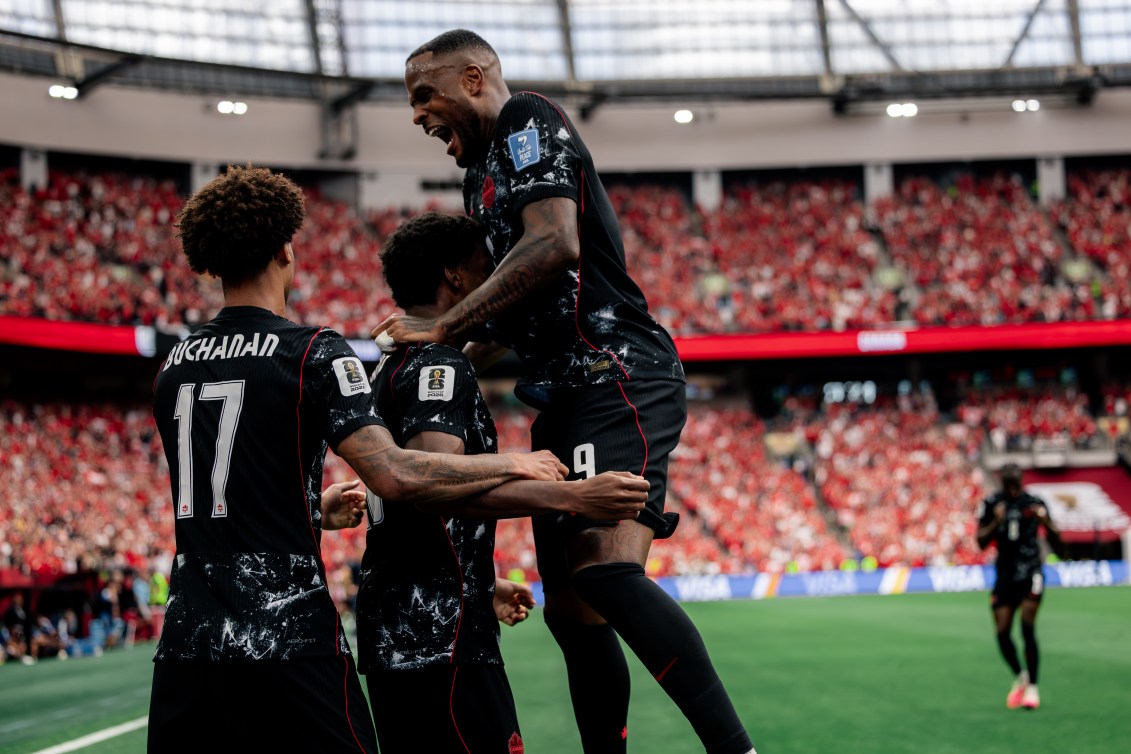
Cyle Larin celebrates with teammates after scoring in Canada’s 6-0 win against Qatar in the group stage of the 2026 men’s World Cup. PHOTO AUDREY MAGNY/COURTESY OF CANADA SOCCER

There are a lot of reasons to want to hedge this, to clear-headedly downplay it. Group stage qualification as a host seeded in Pot 1 was an easier target than in 2022, when the Reds had the lowest seeding in Pot 4. Qatar was ranked 24 spots lower than Canada and at nine men when the last three goals went in. After losing to Switzerland in the final group stage game, Canada still has not pulled off a result against a team ranked better than them.

There is also the question of Alphonso Davies, Canada’s co-captain who has been out with a hamstring sprain with Bayern Munich in the Champions League semifinal in May. He is the team’s best-known player and talisman, and his threat was enough for Marsch to name him as a substitute against Switzerland just to make them have to plan around him.

He was held off till late against South Africa, all eyes firmly on penalties, and it’s hard to imagine not being off-speed making your return in the fast, desperate part of a knockout game. But even if he wasn’t great, he was pretty good, made a few runs and provided the electricity that pushed the team up a level. His presence in the squad, likely as a substitute, will do so again as Canada face down a team in Morocco who beat them at the last men’s World Cup.

That match was giddy and loose, with Morocco taking a lead through a freak early chip of the keeper, doubling it on the counter. Canada drew one back after Sam Adekugbe’s low-driven shot was redirected in for an own goal and Atiba Hutchinson was left watching in disbelief as a possible tying goal bounced off the crossbar, the goal line and back out. 

The Atlas Lions were on their own dream run then to the World Cup semifinals and are now a known quantity in the top ten of the world rankings. They will only be better now than they were then, but for four years, Canada has been rehearsing off that loss, and on Saturday they will be given the biggest stage they’ve ever had to show their results.

So if a moment like Marsch’s post-match promo feels stage-managed, it is, and if “Canadian heroes” feels like schmaltzy Canadian Tire commercial material, it is. But what is at stake for Canada on Saturday is the chance to define themselves through more history-making moments, and to finally feel as though they have arrived, checking almost all the boxes you could imagine leading into the tournament.

Winning, and securing a spot in the quarter-final, was too large an idea to even think about a month ago.

But now, we can dream about it.
Canada’s Gold Cup opener was going okay, I guess, until it wasn’t

Buh. So I watched the first Canadian game in the Gold Cup. Are you sure you want to hear about it?

Martinique aren’t bad so much as they’re static, drawing from a player pool that’s half French oldsters and half natives of the French overseas department. They spent most of the time pushing Canada without finding any luck, going into second-half injury time tied 0-0. That’s sort of a result if your expectations were shattered by the most recent World Cup qualifying campaign but not at all a result when you think that six years ago, Canada were ranked fourth in CONCACAF and now they’re getting bossed around by a non-FIFA team. Milan Borjan was dependable. Canada’s rising stars need more time with each other, and Canada was not without chances.

That would have been something you could settle for, until they scored from outside the box on 93 minutes. By all accounts, Canada need 4 points to succeed, which would mean they need at least a point against Mexico. So there’s that.

Colin Miller’s first squad as interim Canadian MNT boss blows open the field

colinmiller

New Canadian men’s national team interim head coach Colin Miller has named a 22-man roster full of new faces for his January training camp. Photo canadasoccer/flickr

It truly is the first match of a new era.

What did people want when Honduras blew out the Canadian national team 8-1 in the final group stage of World Cup qualifying? Fire? Heads rolling? Exile?

The answer Colin Miller, former FC Edmonton head coach and veteran of the North American soccer scene, has provided turns away slightly from the fire and tends to the green shoots in Canada’s soccer garden.

His 22-man roster has ten new players and an average age of 25; forward Dwayne De Rosario and goalkeeper Lars Hirschfeld will remain, as will a few other famiiliar faces from the last year of the program. But only four players total on this squad (DeRo, Hirschfeld, Ricketts, Ledgerwood) played in World Cup Qualifying last year. Only three (DeRo, Hirschfeld, Dunfield) are over 30.

This isn’t exile. A lot of good players are missing, but North American training camps often omit players in Europe. (Why make Iain Hume, David Edgar, Andre Hainault or Atiba Hutchinson fly across the pond?) Some MLS players got callups, while others (Will Johnson, Ante Jazic) will start their training camps with their clubs. They’re not necessarily out of the picture.

The theme of this squad is not the end of those players, but the beginning of a new pack. The opportunity offered here is incredible: Two games in short procession, one against a Euro 2012 team (23rd ranked Denmark, last seen in a 1-0 win against Canada in 1995) and one will be the newest installation in the USA-Canada rivalry. It is stiff competition.

But with the long view, how could you plan any differently? The third round of 2018 World Cup qualifying will likely be three years from now, and the journey has to begin immediately. If Canada charges the hexagonal final round of CONCACAF’s tournament, it needs to do so with a new core of players and somewhat of a different look from the team fielded the last few years.

So bring TFC’s Matt Stinson, a 20-year-old with six appearances in 2012 and 22-year old Kyle Bekker, who has never appeared. Think about starting Russell Teibert and Ashtone Morgan and Doneil Henry and Jonathan Beaulieu-Bourgault, all with some national team experience but all young and looking for more. Take the players trawled back from clubs in Europe and South America and give them a chance to see what they can do.

Because this is the start of the great adventure for this squad. From these games to the Gold Cup this summer, not all of these players will necessarily figure all the time. But when the time comes, when they are needed, they will remember this camp, and they chance they were given.

Squad after the jump.

Continue reading

Six thoughts on the Whitecaps’ Year Without Canadians

6267952124_a3b07eb41f_z

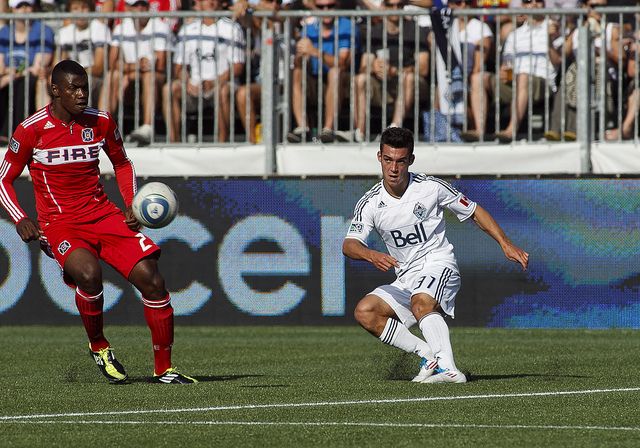
This match on against Chicago a year ago was the last time Teibert–or any other Canadian–has been seen in a Whitecaps uniform on an MLS pitch. Photo courtesy Vancouver Whitecaps FC/flickr

It has been a year since the Vancouver Whitecaps have played a Canadian.

On August 7, 2011, Russell Teibert was subbed on in the 56th minute for Alain Rochat in a 4-2 win over Chicago. Since then, in 38 first team games, not even a single minute has gone to a Canadian international player. This year, the only players, other than the mandatory three Canadians on the Whitecaps roster, that received zero minutes are the third-string goalkeeper and Greg Klazura.

This has been a sensitive subject with Whitecaps fans, who are often sick of hearing about the topic and irascible about the charge that the franchise doesn’t develop Canadians, which, clearly, it does, with strong players at the youth and women’s level and alum on the men’s team. (The argument that Alain Rochat, Canadian-born but capped for the Swiss national team, should count is invalid. If Jacob Lensky signs, that too will be weak. I mean, even Joe Cannon’s eligible for a Canada cap if both sides wanted it. But it’s probably not happening.)

There was a strong connection between the national program and the Whitecaps when the team was in NASL, and it’s mainly gone missing in MLS despite promises that a franchise for the Caps would help transform the program. It’s the elephant in the room. But it’s a little bit more complex than just Canadian teams ought to play Canadians (although that’s not necessarily false), so let’s work through it. I’ll give three reasons why it’s something that’s okay to live with at the moment, and then three why it’s awful.

Why it’s okay

1. They’re trying

The argument for the lack of Canadians from the Whitecaps as a club is perennially that they are working to develop suitable subjects. Pioneering the Residence academy structure has helped, and the strong showing of the club in this year’s USSDA Academy playoffs has proven that there are great prospects like Bryce Alderson and Ben Fisk on their way up. This is a long and painful process, so it’s important not to expect instant results.

2. Can you think of any?

With the exception of any past-or-present Vancouver Whitecaps, which great Canadian players the club can go and get that can make an immediate positive impact in the squad? There are a bunch of sort of okay players bouncing around North America that can’t really make the first-team any more (the Kevin Harmses of the world), the great Canadians in MLS are securely with teams and the ones in Europe are mostly getting better opportunities. Toronto’s experiment with hauling in Julian de Guzman and Dwayne de Rosario ended in tears, so why would it work any better for the Caps?

3. It’s working right now

This is the guiltiest reason of all, of course, but the Whitecaps are playing well right now. There was good squad composition through the beginning of the year, and then after the roster shakeup there is still a great first XI. Nobody else will sympathise with Whitecaps fans on this, especially not Toronto fans that sat through the years starting 2007 when only Canadians counted as domestics. Which brings us to

Why it’s not okay

1. They changed the rules for this

The point of MLS as a league initially was to develop players for the US national team program; the product would be iffy at first, as the demands for players were much larger than the player pool, but it would get better. This is what Toronto was in for. Until the Whitecaps came in to the league, all but 13 of Toronto’s 30 players had to be Canadian. Part of the negotiation necessary to accommodate Vancouver’s club-based academy structure included making US players count as domestics in Canada, and requiring Canadian teams to only carry three truly domestic players.

This wouldn’t be a problem if the Caps weren’t using all three spots on players that haven’t got even a whiff of playing time in the first team. The idea that Caleb Clarke or Bryce Alderson are first-team players (or that Phillipe Davies was) is a farce, because Martin Rennie wouldn’t ever consider putting them on the field. The Whitecaps, in part, helped negotiate the Canadian quota down to a number where they would never have to play them if they don’t want to; and on current evidence, it seems they would rather work with a shorter bench than find players for those spots they would be able to use.

2. Terry Dunfield

I won’t tarry too long here, but it bears saying. Dunfield wasn’t great. But he wasn’t awful, and he was a Canadian, and Tommy Soehn sent him away for nothing. He just beat Julian de Guzman in a competition for places in Toronto. The next time the Whitecaps say they can’t find any good Canadians right now, think of the one they tossed out on a whim.

3. Do they think they’re not good enough?

The Whitecaps first team right now is a lovely cornucopia of nationalities that bends both the mind and the international player rule. There are a lot of great players there! There are a lot of okay players. In substitution situations, they are preferred to Russell Teibert every single time. Andy O’Brian, who is Irish, and Brazilian Tiago Ulisses were just brought in to be okay players. And it seems like the team prefers them not to be Canadian.

This isn’t like, some weird accusation of racism or something! The fact is that what you battle in the growth of a program is stereotypes and prejudice. Players like Paul Pechisolido and Paul Stalteri were evidence that Canadians could do well in England. Canadians need to prove they can earn their keep in a top flight. When the Whitecaps say “we want Canadians, we just want to develop them ourselves”, that might translate to an opinion that Canada has not produced any MLS players worth getting, and we have to make them ourselves to trust them. That’s the problem.

There are clubs where the coaching staff believe that Canadians aren’t up to snuff and can’t compete, and the battle is convincing them that they are wrong. It’s just bitter that the Whitecaps are one of those clubs.

Continue reading